
Nassau County Deed Records and What They Show
Deed records, assessment rolls, GIS maps, and tax bills come from separate Nassau County systems. They rarely disagree outright. Still, each was built for a distinct purpose. Comparing the SBL and address across them shows whether a deed, an appraisal, or a tax roll is the right record for your question. Treat every result within the limits of that record.
| Deed Type | What It Does | Common Use |
|---|---|---|
| Warranty deed | official record detail | official record detail |
| Quitclaim deed | official record detail | official record detail |
| Grant / special warranty | official record detail | official record detail |
| Trustee / executor deed | official record detail | official record detail |
| Tax deed | official record detail | official record detail |
Recorded land documents sit with the County Clerk. Assessment data, parcel geography, and tax administration live elsewhere in Nassau County. Match the SBL and street address across these systems before trusting any single entry. A deed proves ownership of record. An assessor file proves valuation. Each answer depends on which Nassau County property records you pull, so pull with the purpose in mind.
The Nassau County Grantor-Grantee Index
The grantor-grantee index works like a ledger of names. Every deed recorded with the Nassau County Clerk lands there, listed under both seller and buyer. Assessment data, parcel geography, and tax rolls sit in separate systems run by other offices. Compare the SBL and address across them. Each record answers a different question.
- Open the Land Records Viewer and search the street address without a directional prefix or street suffix.
- Copy the section, block, and lot from the selected parcel and note the Town and Village fields.
- Search the County Clerk index by party name or reconciled SBL and inspect the latest deed.
- Compare assessment, sale, tax, and parcel-map details, then check the relevant city or town permit office.
- Grantor
- official record detail
- Grantee
- official record detail
- Chain of title
- official record detail
- Book/Page vs Instrument #
- official record detail
Getting a Copy of a Nassau County Deed
A certified deed copy comes from the County Clerk. That office records land documents in Nassau County. The Department of Assessment, GIS service, and Treasurer keep parcels, maps, and tax bills in their own systems. Bring the SBL and address. Then ask the right office for the record it keeps.
Recorded, not guaranteed. Use these public records for lawful property research and verify important conclusions with the custodian, a title professional, or a licensed surveyor. Never use owner information to harass or harm anyone.
Nassau County Deed Index Coverage Has More Than One Date
Two different dates appear in Nassau County deed records coverage, and they mean different things. The Clerk's guide places the start of the electronic land database in July 1992. The public search notice says online images run from February 22, 1994 forward. Older documents are added over time. The first date covers indexing. The second covers viewable images. A deed can be indexed in the system yet lack a remotely viewable image. An older deed may still wait in a book, on a property card, in a direct or reverse index, on microfilm, or in the historic repository.
That repository reaches back to 1840 and runs through 1982. It includes direct and reverse indexes. It also holds index books spanning 1840 through 1934, and historic and official plat books. Search by grantor to move forward in time. Search by grantee to trace backward. At every step, note the liber and page, the recording date, the instrument type, the exact party spelling, and any map reference. Each link in the chain depends on the one before it.
Copies, Fees, and Public Access at the Nassau County Clerk
Fees at the Nassau County Clerk are simple but worth knowing in advance. The Mortgages and Deeds guidance lists a $10 certified-copy charge. It includes a $5 search fee. A downloaded image, an uncertified office copy, and a certified copy are not interchangeable. A closing, a court filing, an estate, or a correction may each demand a specific form. Ask the recipient before ordering.
The offline route runs through the Land Records Room and map room. Both sit at 240 Old Country Road in Mineola. The map room keeps section-block-lot maps and lists condominium, cooperative, and wetlands maps. A certified deed settles what the recorded text says. A dispute may turn on dimensions, monuments, easements, or encroachments. Then you still need the map or the survey itself.
Watch Nassau Deed Records for Related Instruments
A deed is one link in the chain, never the whole chain. Search the same parties and parcel for mortgages, assignments, satisfactions, liens, judgments, notices of pendency, easements, powers of attorney, and map filings. Map filings belong in the same search. A satisfaction releases a mortgage. An assignment moves it to a new holder. Neither transfers ownership on its own. Estate and trust transfers may use executor or trustee instruments, and a Surrogate's Court file may explain the authority behind them.
Nassau County's free Property Fraud Alert sends an email. It sends one when a document is recorded against a chosen name or SBL. It is a monitoring aid only, not a ruling on whether a filing is genuine. The Clerk also warns about costly private deed-copy solicitations. Compare any invoice with the official Clerk procedure before paying. The official County Clerk land-record portal posts its search notice and image coverage.
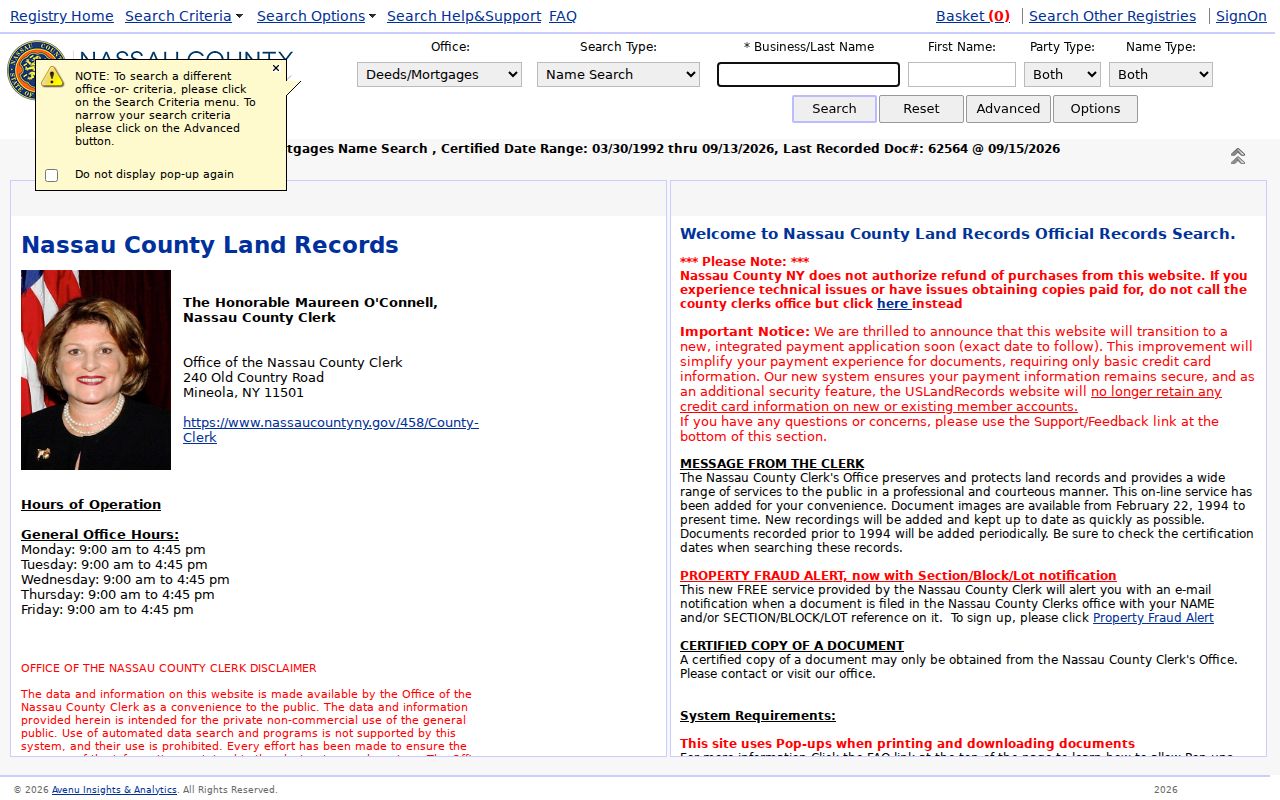
The notice tells a deed researcher when the office itself, or the historic repository, holds what the online system does not.
Build a Reliable Nassau County Deed Abstract
Every entry in a Nassau County deed abstract should capture the same core fields. Record the execution date, recording date, grantor, grantee, deed type, and consideration. Add the SBL and the liber/page or instrument number. Note any schedule holding the legal description. Copy names letter for letter before testing variants. A deed may carry an entity, a trustee, an executor, or a former name. A marital style may look nothing like the assessment roll entry. Keep execution and recording dates separate. The recording date only marks when the deed entered the public record, not when the parties signed.
Read each instrument in full. The granting clause fixes the transfer, while the vesting language shows how title is held. Schedules may define the land or carve out exceptions. Prior deeds, filed maps, easements, covenants, and rights-of-way each hand you the next search key. A quitclaim passes only what the grantor holds, with no promise that the interest is valid. Executor and trustee deeds rest on representative authority that a probate or trust record may explain.
Work outward from every deed in both directions. A purchase is often followed by a mortgage. A later satisfaction shows that mortgage was discharged. Assignments move the lender, never the fee owner. A notice of pendency flags litigation touching the parcel, and judgments or liens may need their own releases. Treat no encumbrance as active simply because the original filing exists. Hunt for later satisfactions, releases, cancellations, or court dispositions before drawing conclusions.
Older deeds sometimes rely on a subdivision or street description alone. In that case, set the filed plat beside the tax map and the modern SBL. Reconcile all three. Nassau County's map room is a strong resource for condominium, cooperative, and wetlands records. Use GIS for orientation only. When monuments, access rights, or the legal description drive a real decision, order the recorded map and a current survey. Also get professional title advice. Never mistake an index abstract for a title search.
Research note: Preserve the exact deed reference and SBL before leaving a result, because name searches alone can join unrelated parties.
An honest abstract admits its gaps. An unreadable schedule stays on the worksheet as an open item. A missing release does, too. So does a break before the electronic era. Let that open item point you toward the next office, volume, or professional search.
Number every transfer in a long chain. Put the oldest confirmed Nassau County deed at the bottom. That layout makes a missing acquisition jump out. A duplicate party or an unexplained parcel change does, too. Spotting gaps early saves you from ordering copies you do not need.