
How to Search Nassau County Property Records
Assessment, recording, mapping, and taxation each run in their own Nassau County system. The assessor maintains the roll. The County Clerk records deeds. The tax receiver bills on those values.
Pulling the same section-block-lot and street address through each source shows where the answers agree or diverge, since every record carries only the meaning its own office gives it. Compare results before relying on any one of them.
- Open the Land Records Viewer and search the street address without a directional prefix or street suffix.
- Copy the section, block, and lot from the selected parcel and note the Town and Village fields.
- Search the County Clerk index by party name or reconciled SBL and inspect the latest deed.
- Compare assessment, sale, tax, and parcel-map details, then check the relevant city or town permit office.
- Request an official or certified copy from the custodian when the online result is incomplete.
Nassau County Property Records Offices
Nassau County property records never sit in one office. The assessor handles valuation. The Clerk, tax receiver, and mapping staff each hold a different piece of the picture.
Nassau County Recorder / Register of Deeds
240 Old Country Road
Mineola, NY 11501
516-571-2660
Nassau County Assessor / Appraisal District
240 Old Country Road
Mineola, NY 11501
516-571-2660
Nassau County Treasurer / Tax Collector
240 Old Country Road
Mineola, NY 11501
516-571-2660
Types of Nassau County Property Records
Each record type answers a different question. A deed proves a transfer. An assessment card, tax roll, parcel map, or plat covers value, taxation, and boundaries instead.
| Record Type | What It Documents | Kept By | Access |
|---|---|---|---|
| Deeds | ownership transfers and recording dates | Nassau County Clerk | free index; image fees may apply |
| Mortgages & liens | recorded loans, releases, and encumbrances | Nassau County Clerk | free index search |
| Tax & assessment | roll values, exemptions, and tax status | Department of Assessment and Treasurer | free public portal |
| Plats & parcels | reference parcel geometry and recorded map context | Nassau GIS and County Clerk map room | free public viewer |
| Building permits | permits, inspections, certificates, and zoning files | city, town, or village office | official request or municipal portal |
The recorder, assessor, and tax offices create separate documents. Deed records establish ownership history. Appraisal and tax roll entries track value over time.
What Nassau County Property Records Can and Cannot Tell You
Records have limits. The owner of record can lag. A newly recorded deed may not appear on the annual assessment roll yet, and GIS maps show geography rather than legal boundaries.
Lawful use. Use these public records for lawful property research and verify important conclusions with the custodian, a title professional, or a licensed surveyor. Never use owner information to harass or harm anyone.
Nassau County's SBL Connects the Record Systems
The section-block-lot number, or SBL, is the strongest link between Nassau County property records. The viewer asks for Section, Block, and Lot separately. The Clerk's system may format the same numbers differently, with odd spacing or leading zeroes. Copy the identifier exactly. Then compare the street address and legal description. Two differently formatted strings can still describe the same land. Condominium units, lot groups, and map references add detail a short SBL leaves out.
The viewer's address form wants house number, street, town, and ZIP. Its local instructions say to drop directional prefixes and street suffixes, so a failed search for North Main Street should be retried as Main. The parcel is probably there. Town and Village fields matter too. Nassau County spans three towns, two cities, and 64 villages. A postal place name is not always the governing municipality.
Reading the Nassau Land Records Viewer
The assessment card gathers several public record streams without merging them into one legal record. Tabs cover property description, recent sales, values, taxes, exemptions, photographs, and My Nassau Info. Check the roll year. Mark whether each figure is tentative or final. The card's Last Known Owner Name is an assessment field. A later deed may already be recorded.
A simple worksheet helps. Keep situs and tax mailing addresses apart. Record the SBL, class, school district, village, and year built. Note lot size, structure, values, and deed clues. With those facts saved, the County Clerk index can confirm the latest recorded transfer. That cross-check matters most after a sale, an estate event, or an entity transfer, when the annual assessment roll may lag the recording system.
The official Land Records Viewer search form shows the address and SBL inputs that start the comparison.
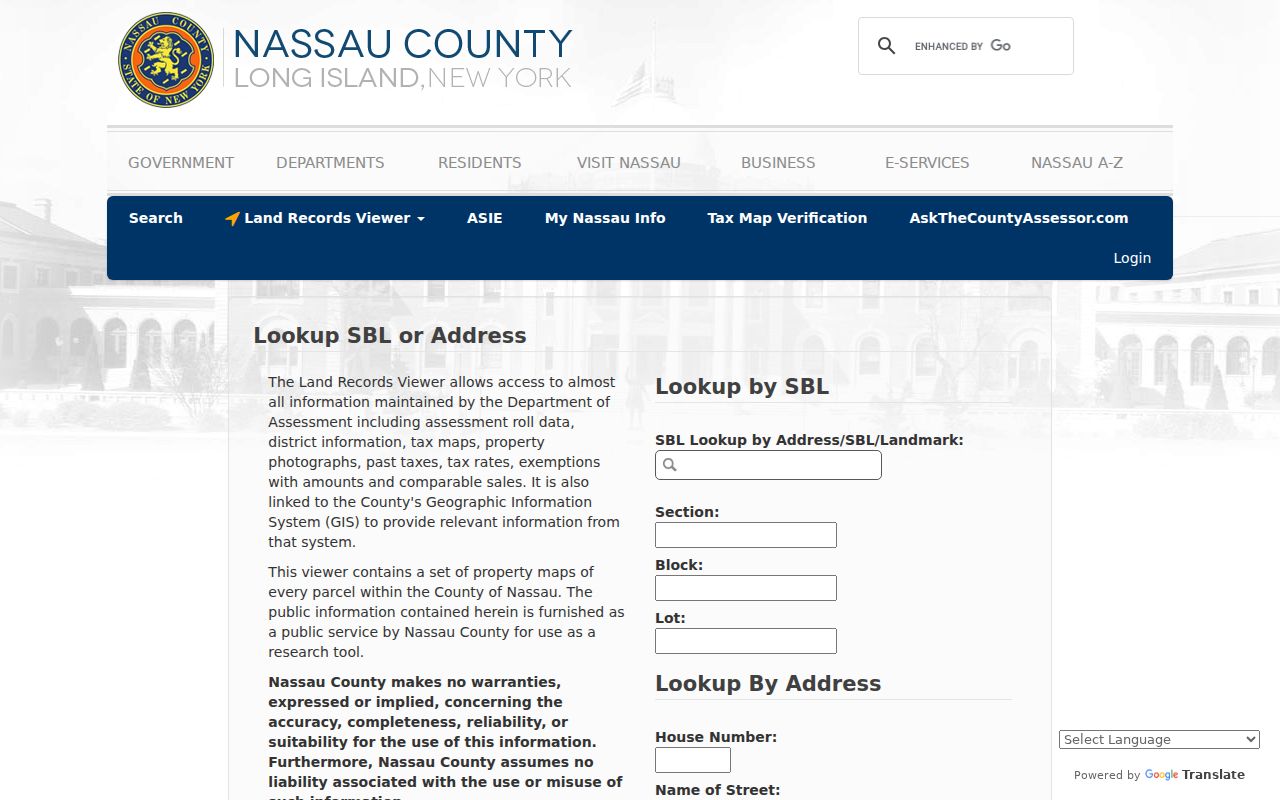
The viewer's search page is the natural first stop. It displays the address and SBL inputs, and the resulting parcel number should be carried into later Nassau County searches.
Recorded Deeds, Maps, and Historic Coverage in Nassau County
The Nassau County Clerk records deeds, mortgages, satisfactions, assignments, liens, judgments, notices of pendency, powers of attorney, and map filings. The electronic database reaches back to July 1992. Document images run from February 22, 1994 forward. Some older items were added later. An empty image result does not mean no earlier conveyance exists.
Older research moves through direct and reverse indexes, property cards, deed books, microfilm, plat books, the Clerk's historic repository, and public terminals at 240 Old Country Road in Mineola. The repository holds material from 1840 through 1982. It includes direct and reverse indexes plus historic and official plat books. A chain of title can cross several formats. Preserve each grantor, grantee, date, document type, and book or page reference while working backward. That discipline keeps the chain intact.
Assessment Review, Taxes, and Sale Clues
Nassau County splits assessment work between two offices. The Department of Assessment maintains the tax roll. The Assessment Review Commission hears challenges through AROW. Filing is available online, by mail, or in person, with no filing fee charged. AROW also provides an address or parcel search. A sales locator there compares one- and two-family sales. Treat its sale results as informational only, since they do not constitute an appraisal.
Taxes follow a second divide. Municipal receivers issue current bills within their own jurisdictions. The County Treasurer, meanwhile, handles the delinquent-tax route. Check the correct municipal bill source before treating any county delinquency screen as final. Assessed values, exemptions, bill status, and recorded sale consideration answer different questions. They can legitimately differ.
Nassau County Record Access Beyond the Main Portals
Online tools are the fastest way in. Nassau County property records also live at desks, in archives, and through formal request channels. The County Clerk's public terminals and Land Records Room support deed and lien research. The map room adds tax, condominium, cooperative, wetlands, and recorded map context. The Department of Assessment keeps the annual roll and parcel viewer. Municipal receivers answer current-bill questions. The County Treasurer covers delinquent taxes. ARC hears assessment challenges. Keeping those roles straight keeps a searcher from asking one office to certify another office's record.
New York's Freedom of Information Law helps when an agency holds a record. That record may not be routinely posted. Public Officers Law Article 6 generally requires an agency to grant access, deny access, or acknowledge a request. The deadline is five business days. Need more time? The acknowledgment should give a reasonable approximate date. Standard paper copies can cost up to $0.25 per page. That rate applies to pages no larger than 9 by 14 inches. A narrow request works best. Identify the address, SBL, record type, office, date range, and preferred electronic format. FOIL cannot override statutory exemptions, sealed court files, or protected personal information.
Court and estate records can explain land events without replacing the deed. New York eCourts links WebCivil Supreme, WebCivil Local, WebSurrogate, WebCriminal, and NYSCEF. Nassau Supreme Court posts foreclosure information and a sales calendar. A notice of pendency in the Clerk index may point to litigation. The docket supplies procedural context. Nassau Surrogate's Court can clarify an executor or estate transfer. Still, the latest recorded conveyance remains the proof of a land transfer. A docket caption alone does not.
Historic Nassau Property Research Uses Local Collections
Nassau became a county in 1899. Its land record trail reaches further back, through predecessor indexes and the Clerk's historic collections. The registry moved from index books to property cards. Then it went to an electronic database in July 1992. That layered history is why no single online query returns a complete chain. Record every old spelling, subdivision name, liber/page, and map number before switching formats.
Glen Cove's History Room holds the Musketa Cove Proprietors' Records from 1668 through 1803. It also holds the 1677 Andros Patent, estate and family papers, maps, newspapers, directories, and oral histories. Its Orchard collection uses a 1908 Sanborn map and the 1923–24 Polk directory to place homes and shops. It documents the Maple-to-Stanco and Willow-to-Capobianco name changes. The Long Beach Public Library preserves barrier-island maps, photographs, construction images, hotel and canal material, beaches, transportation records, and oral histories. These collections enrich the story. But every ownership conclusion should return to the deed, tax roll, or probate instrument.
Public access has limits. Recorded instruments can contain outdated details, and the Clerk warns filers against including sensitive identifiers. Reproduce only the parcel, party, and recording details needed for legitimate research. Remember that a record search is not a title opinion. It is also not a boundary survey, appraisal, or proof of occupancy. When legal reliance matters, certified copies, professional title work, and a licensed survey remain the right tools.
A Practical Nassau County Verification File
Keep a source log, not a stack of unlabeled screenshots. For each item, note the office, portal or volume, access date, search terms, SBL format, roll or recording year, document reference, and what the source actually proves. Save the result page alongside any deed image, map, or municipal response. If two sources conflict, keep both and compare effective dates before concluding anything.
A finished file should separate ownership, value, tax status, physical description, land-use approval, and boundary evidence. Ownership rests on the recorded conveyance chain, supported by the current roll. Value fields come from a dated assessment record. A sale, by contrast, comes from a verified transfer. Tax balances belong to the correct receiver or Treasurer. Permits and zoning decisions document approvals or enforcement. Recorded maps, deeds, monuments, and surveys settle land description. This discipline is what makes Nassau County property records useful, without asking any single public database to prove more than it can.