
The Values on a Nassau County Property Record
One office rarely holds everything here. The systems sit apart. Nassau County keeps assessment, deed records, parcel geography, and tax administration on separate official systems, so compare the SBL and address across each source and treat every figure according to the purpose and limits of that record.
| Value | What It Is | Where |
|---|---|---|
| Assessed value | official record detail | official Nassau County record details |
| Market / appraised value | official record detail | official Nassau County record details |
| Last sale price | official record detail | official record detail |
| Land vs improvement | official record detail | official Nassau County record details |
Every value has a source. Each system serves one job. Nassau County runs assessment, recorded land documents, parcel geography, and tax administration separately, so compare the SBL and address across them and treat each result within the purpose and limits of that record.
Looking Up a Nassau County Property Value
A parcel value is never one number. The county's official systems are separate. Nassau County handles assessment, recorded land documents, parcel geography, and tax administration in distinct systems, so compare the SBL and address across each and treat every result according to what that record was meant to do.
- Open the Land Records Viewer and search the street address without a directional prefix or street suffix.
- Copy the section, block, and lot from the selected parcel and note the Town and Village fields.
- Search the County Clerk index by party name or reconciled SBL and inspect the latest deed.
- Compare assessment, sale, tax, and parcel-map details, then check the relevant city or town permit office.
- Assessed value
- official record detail
- Market / appraised value
- official record detail
- Level of assessment
- official record detail
What a Nassau County Assessor Value Is Not
What a value is not matters too. No single figure does it all. Nassau County runs assessment, recorded land documents, parcel geography, and tax administration on separate systems, so compare the SBL and address across each source and treat every figure within the purpose and limits of that record.
Value vs price. Use these public records for lawful property research and verify important conclusions with the custodian, a title professional, or a licensed surveyor. Never use owner information to harass or harm anyone.
Nassau County Value Fields Describe Different Things
The Land Records Viewer shows a lot at once. A single parcel card can display fair market value, effective market value, assessed value, level of assessment, class, and a year-specific roll status. Those fields answer different questions. The assessed value exists to support tax administration. The fair and effective market fields are roll calculations, while a recorded sale price is simply the consideration from a past transfer. None of them is automatically a current appraisal, so save the year and the tentative or final label with any figure, because comparing unlabeled numbers from different roll years creates a false trend.
Compare the Parcel Card With Recorded Sales
The parcel card carries more than numbers. Its Recent Sales and Property Description tabs hold deed clues, class, year built, structure details, and sale conditions. Follow a liber page into the County Clerk index. Use a party name there too when a transfer needs verifying. Not every entry is a market sale. A zero-dollar figure can reflect a family transfer. An unusual factor might point to a trust, estate, or corrective transfer instead. The official Glen Cove sample parcel card lays out the value and description fields. It also shows the physical-characteristic and sale fields on one page.
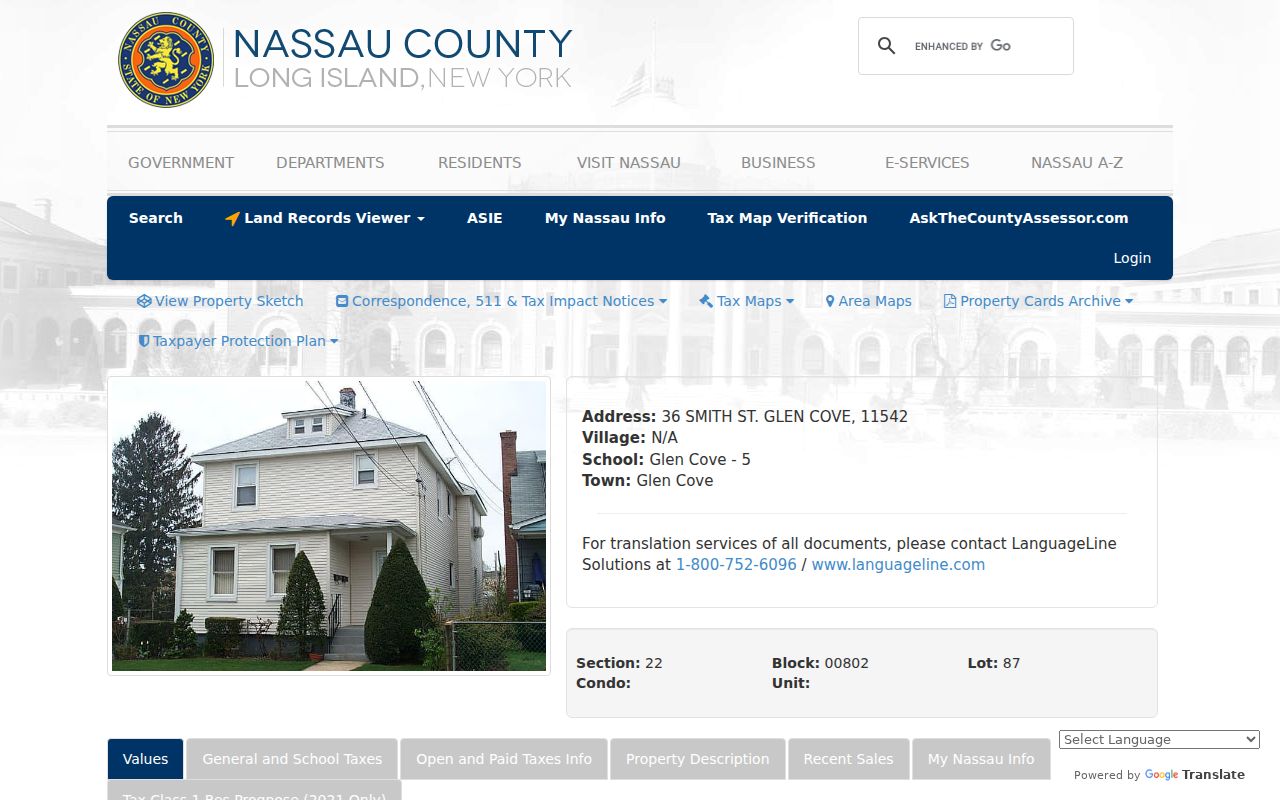
The example makes the point plainly. Sale history and roll values belong together on the page, yet not every transfer counts as a market transaction.
Use AROW Comparables With Care
AROW, the Assessment Review Commission's system, offers address or parcel access plus a sales locator for one- and two-family comparison work. Treat its results as informational. They are not an appraisal. Before another transfer counts as context, match property type, location, sale date, and physical features. Exemptions can shift taxable treatment. Physical changes matter too: municipal permits or certificates may explain a new addition, conversion, or post-storm reconstruction, though they do not set market value on their own.
Value limit. A Nassau County assessed value is a tax-roll figure, not a promise of what the property would sell for and not a professional appraisal.
Explain Changes in a Nassau County Property Value
Like fields deserve like comparisons. Compare the same value across consecutive roll years. A rise in fair market value is not a rise in assessed value, and a change in the taxable amount may trace to an exemption rather than the underlying valuation. Save the class, level of assessment, tentative or final status, and effective date with every figure. Skip those labels and the trend misleads.
Physical data can explain what changed. The parcel card may list year built, building type, living area, lot size, and other characteristics. City or town permits and certificates can document an addition, conversion, demolition, reconstruction, pool, deck, or bulkhead. Long Beach offers a clear case. After Sandy, its reconstruction files show how building work can alter the assessed description while a permit still says nothing about sale value.
Recorded sales need close review. Confirm the deed and the parties first. Then read any sale-condition or unusual-factor notes on the parcel card. A family transfer, trust funding, estate conveyance, foreclosure-related deed, corrective deed, or zero-dollar entry may not work as a market comparison. Even an arm's-length sale carries its own date and property. It cannot promise today's price for a different parcel.
Location matters, but keep it evidence-based. Glen Cove's waterfront redevelopment and its 2024 comprehensive plan frame Garvies Point and nearby land-use change. Long Beach parcels differ by ocean, channel, canal, walk, grid, and resilience settings within one compact city. Those facts are context, not an appreciation rate. Compare parcel-level LRV values and verified sales rather than calling a neighborhood fastest growing without an official dataset.
Report a Nassau Property Value With a Date
Report every value with its paperwork attached. State the value type, amount, roll year, status, class, and official source in one sentence or table row. Add the date and condition of any recorded sale. For AROW comparisons, save the criteria and note that the tool is informational.
That format keeps unlike things apart. A reader can tell a tax-roll number from a transaction and from a professional appraisal, and updates stay simple because you add or replace a dated row instead of overwriting the historical figure. Then the reason the values differ survives.