
How a Nassau County Property Search Works
A Nassau County property search draws on separate official systems. Each one handles a different job. Assessment rolls, recorded land documents, parcel geography, and tax administration sit in their own databases. So no single result speaks for the rest. Match the SBL and the street address across those sources. Then weigh each record by what it was built to do.
- Open the Land Records Viewer and search the street address without a directional prefix or street suffix.]
- Copy the section, block, and lot from the selected parcel and note the Town and Village fields.
- Search the County Clerk index by party name or reconciled SBL and inspect the latest deed.
- Compare assessment, sale, tax, and parcel-map details, then check the relevant city or town permit office.
- Request an official or certified copy from the custodian when the online result is incomplete.
What a Nassau County Property Record Shows
What a Nassau County property record shows depends on which office produced it. Assessment, recording, mapping, and tax work sit in separate systems. Compare the SBL and address across them, and treat each result according to what that record was meant to establish.
| Owner of Record | official record detail |
|---|---|
| Situs / Mailing Address | official record detail |
| Parcel Number (APN) | official record detail |
| Assessed / Market Value | official record detail |
| Legal Description | official record detail |
| Last Sale | official record detail |
Every Nassau County property record answers one question. No single file answers them all. Deed records, assessment rolls, parcel maps, and tax bills come from separate official systems that do not always agree, so run the SBL and address through each source and apply every result only where it carries weight.
Search by Address, Owner, or Parcel
Address, owner, and parcel searches open different doors. Nassau County indexes each official system its own way. The assessor's roll, the Clerk's deed index, and the GIS map answer different questions, so run the SBL and situs address through all of them and weigh each hit by what that record establishes.
| Search Key | Best For | Where It Works | Watch Out |
|---|---|---|---|
| Address | official record detail | official Nassau County record details | official record detail |
| Owner name | official record detail | official Nassau County record details | official record detail |
| Parcel number | official record detail | official record detail | official record detail |
Not a title search. Use these public records for lawful property research and verify important conclusions with the custodian, a title professional, or a licensed surveyor. Never use owner information to harass or harm anyone.
Use Nassau County Address Fields the Way the Portal Expects
The Land Records Viewer rewards careful typing. Enter the house number and street stem only. Leave off directional prefixes and street suffixes. Add the town or ZIP just when the result list needs narrowing, then open the likely match and verify its Town, Village, school district, and full situs address before copying the SBL. Small things derail a Nassau County property search: stray punctuation, a suffix, an old street name, or a postal place that differs from the legal municipality.
Keep the tax mailing address separate. It may point to an owner, a manager, a trust, or an entity far from the parcel. It does not establish who occupies the land. Two addresses often travel with one parcel, and confusing them is the most common error in a Nassau County property search. The situs address locates the improvement on the ground, while the SBL ties the parcel to assessment, the GIS map, and deed records kept by the recorder.
Cross-Check a Nassau County Search in the Clerk Index
The County Clerk's official index rewards patience. Search a surname and given name in several arrangements. Try an entity with and without punctuation. Bring the SBL from the assessment result, but reconcile its format first, since the Clerk and assessment systems display leading zeroes and block components differently. The same index handles both party-name and document-criteria research for recorded deed records.
The electronic database began in July 1992, and the online notice places general image availability at February 22, 1994 to the present. Earlier images are added periodically. Older title work may still require index books, cards, microfilm, or the historic repository. Public terminals are open at the Clerk's Mineola office. Staff will not perform full ownership research by telephone or email. The official Nassau land-record search explains its coverage and image access.
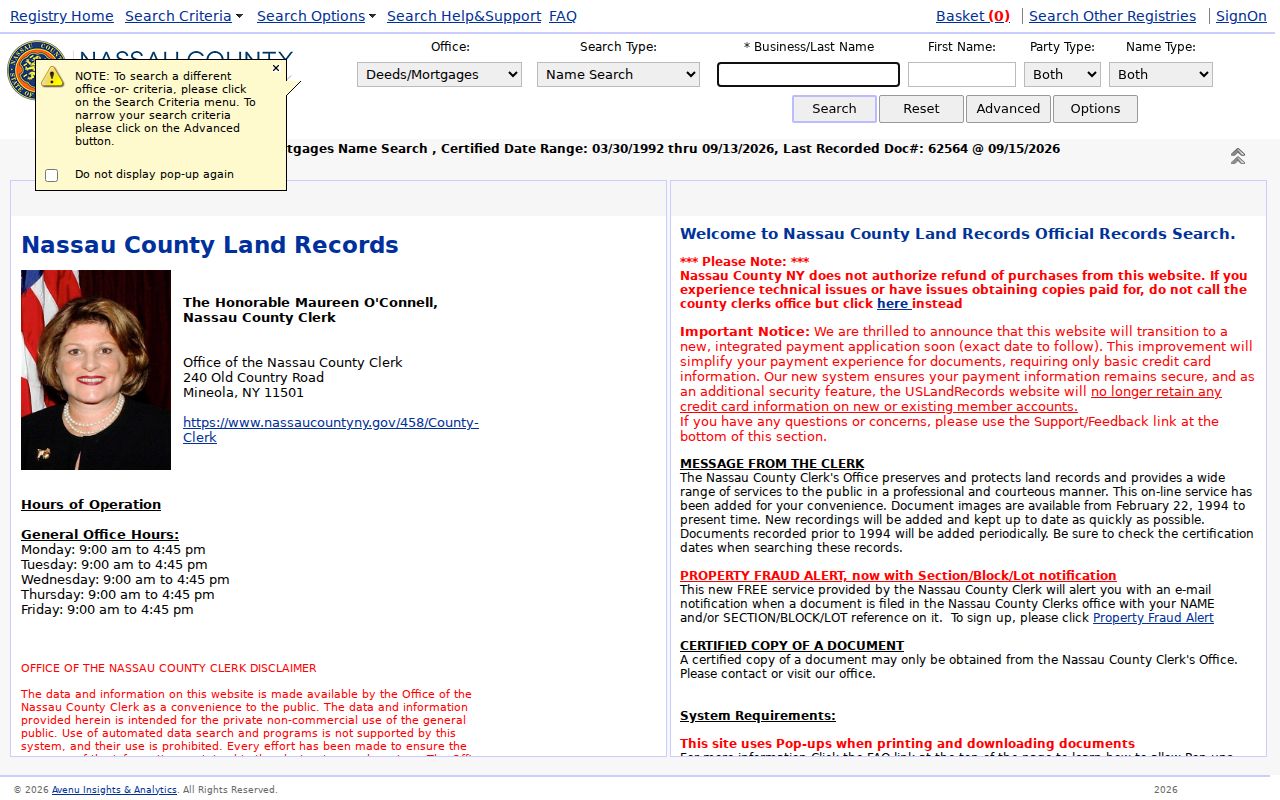
A free index result is not a purchased image. Neither is a certified copy, so know which tier of the Nassau County deed records you need before ordering anything.
What a Complete Nassau County Property Search Saves
Save what a complete Nassau County property search produces. Capture the address, SBL, roll year, and tentative or final status. Keep the owner, mailing address, class, values, and exemptions. Add liber and page references. Include the Clerk's recording date, document type, parties, and instrument reference. When a boundary or access question appears, pull the recorded plat and a current survey. Do not treat the GIS line as conclusive.
House history widens the net. City and town permits, certificates of occupancy, zoning decisions, newspapers, and directories all help. Historic maps help too. Glen Cove's History Room documents the Maple and Willow street names. They became Stanco and Capobianco. Long Beach records may lean on neighborhood terms. These include West End, North Park, President Streets, Canals, or Walks. Local names recover results a modern address misses.
Use the Offline Nassau County Search Route
Not every useful record is indexed online. The County Clerk keeps public terminals, land-record staff, books, maps, and historic formats at 240 Old Country Road in Mineola. A certified deed request follows the Clerk's procedure. The stated $10 charge includes a $5 search fee. When a file is not routinely posted, New York FOIL is the formal fallback. An agency generally must grant, deny, or acknowledge a request within five business days and give a reasonable approximate date when more time is needed.
A focused request saves everyone time. Identify the property by address and SBL. Name the record type, give an approximate date range, and ask for the preferred electronic format. For a permit search, add the owner or applicant, the work type, and the project year, so the custodian can go straight to the right file.
Search Nassau County Sales, Courts, and Municipal Files
A parcel search often leaves a second question open. The assessment screen rarely answers it. For comparable sales, AROW's locator covers one- and two-family properties with criteria and result rows. The county cautions that this material is informational, not an appraisal. Foreclosure context lives elsewhere. The Nassau Supreme Court page posts its foreclosure unit, sales calendar, forms, and contacts. Search the Clerk for the notice of pendency and the later deed. A calendar entry alone does not prove title changed hands.
Municipal files complete the physical history of a parcel. Glen Cove's Building Department handles permit and zoning applications, certificates, inspections, complaint material, and a zoning-map link. Long Beach covers even more ground. Its Building Department spans permits, certificates of occupancy, complaints, zoning, electrical, plumbing, sanitation, and post-storm reconstruction. Where no public address index exists, ask with the address, SBL, owner or applicant, and date range. Include the work type too. A permit applicant is not necessarily the owner.
Address history can rescue a failed Nassau County property search. Glen Cove records may say Musketa Cove, Garvies Point, Landing, Dosoris, or Welwyn. An older street name can also appear. Long Beach material may use West End, East End, Westholme, North Park, Central, and President Streets. It may also use Lido Beach, Canals, or Walks. Search each local term separately. Then match it to the SBL and legal description. ZIP Codes like 11542 and 11561 are delivery constructs. They are useful inputs but no substitute for the Town and Village fields.
Owners are often LLCs or corporations. The New York Department of State entity database clarifies the exact legal name, status, and DOS identifier. It also gives the service-of-process address. Those facts separate similar names. Still, a service address is not the parcel address, and an agent is not automatically the beneficial owner. Nassau County Clerk business certificates add DBA context. The deed settles title, and the municipal file tells the project story.
Troubleshoot a Nassau County Property Search
A dead address search can usually be revived. Drop the street suffix and direction, try the street stem, check a former street name, and search with and without the ZIP. Too many results calls for a different filter. Compare Town, Village, school district, and the full situs address. If the SBL fails in the Clerk index, strip display punctuation, test leading zeroes, and verify the block or lot grouping against the parcel card and tax map.
Weak owner-name results have their own fixes. Reverse given and family names. Test middle initials and prior surnames from the deed. Search an entity with and without punctuation, and take a trust under the trustee and the wording actually recorded. For an older chain, move from the online notice to the historic repository, using direct and reverse indexes, books, cards, or microfilm.
Sometimes the record itself is wrong. Contact its custodian with the source reference and a supporting document. The assessor handles roll data. The Clerk handles recorded instruments and indexing, while the Treasurer or municipal receiver handles tax status and the local building office handles permits. A search problem is not a legal ownership dispute. The latter calls for title evidence and professional advice.
Search note: Keep each official result with its access date.